Showing posts with label libraries. Show all posts

Saturday, December 12, 2009

The Mail Order Library (Part 2)


In the last post I talked briefly about an idea for a mail order library. Today I'm going to talk about the book tracking systems that would be needed for such a thing to occur. I'm more than likely to touch upon a few other systems, but only as it pertains to the general tracking.

The first thing to be encountered by a patron is the website and database. Besides allowing access to the system, it would also provide a great place for book reviews and/or talks, as well as other tools that might be of interest to a reader looking for a new book to read. While all that would, and should, be on the website, the main focus will be on the display of information from the database.

Let us start with the search. The database should be able to be searched by
author, book tile, and subject. Those are your basics and are already options
in the current inter-library loan system. Our system, though, will also allow
someone to search on a character name, quote, and publisher. Of course you
could also run a search with filters. Once the patron finds a book they are
interested in they click the link and all the information from the database on
that book is pulled up, including a basic synopsis of the book. As a way to
make money, a link to Amazon.com or some other site to buy the book, could be
posted.

"That's all fine for someone that knows what they are looking for. What about
the person that just wants to look around and see what he finds?" We can do
that too! The site should be set up in such a way that it makes for easy
navigation. One feature that should be included would be book suggestions based
on previously checked out books. There would also be an option to add 'books
you like' to the system so that you don't really need to check out books you may
own just so that the system knows the type of books you enjoy.

So the book is ordered, what now? Well at a set time each day all the orders
from the last 24 hours and any holds that are available are printed out by the
computer, by Dewey decimal. the librarians than get all the books the package
them up. They are then shipped to the patrons that ordered them. Now comes a
little confusion. Normally I would say that people could keep books as long as
they want, but then people would just collect books from the library and never
give them back. So I think that a credit card should be left and books can be
borrowed for up to a month. Or, a better idea that keeps with the whole free
thing, is to limit the amount of books that a person or household may have out
at any given time. After that, once the book is returned, it is run through the
computer has being available and the cycle continues on.

There are certain other considerations that need to be taken into account, but
I feel that something like a mail-order library would work out very well. With
the fast paced environment that most of us lead these days, it would be nice to
just be able to 'order' a book and then have it show up. Take a look at
Netflix if you don't think people are either to busy or to lazy to go out to
the video store, or library.

Monday, December 07, 2009

The Mail Order Library (Part 1)

I went to the library today, I go almost everyday so that's nothing new, and as I was looking through the shelves I got to thinking about my use of the Inter-library Loan System. Both myself and my girlfriend use it quite extensively. I have often times thought that it would just be easier to have the books delivered right to the house (most of my library visits are to get books that have arrived). My question is why can't I get books delivered right to the house? Why not cut out the trips to the library almost entirely? I think it can be done, and why it hasn't been I don't know.

I'm assuming that all of you know what the Inter-library Loan System is. Almost all libraries are on one network at least. My idea is just an extension on that system. Why not have one repository of books in the state, as book warehouse as it were. This warehouse would hold copies of almost all the books in the state library system, except for reference material. The local library could then be reduced in size since a person would really only need to go to use the computers or get access to reference materials. For all the other books, they are ordered online and delivered either to the local library or right your home.

This model, of course, can also be adapted to a commercial venture.  Just think Netflix for books! With public libraries though, it makes it hard to convince people to pay for a service that they can get for free. The only think paying would get would be home delivery. This could also be used with the Nook's lending feature (sorry kindle fans, you guys don't have it... yet) making it possible to borrow books for you e-reader for whatever price the service was
going for.

Tuesday, November 10, 2009

Love and Hate for the Public Library

The library, a bitter sweet institution of acquired knowledge and learning. Dedicated to preserving the accumulated writings of the world. In so doing so, though, it has also taken actions against books that make any true bibliophile cry in horrid despair. In an attempt to provide free books to read to the masses, they have taken to rather destructive practices. At cross purposes within itself, the library is an unpalatable gruel of life sustenance that I frolic in with overabundant joy. It's a curse.


The experience of a library is meant to be enjoyed and savored like a fine meal or wine. One must allow ample time to browser and select books with care. Rashness or hurried browsing more often than not leads to making a bad selection. The library opens doors and windows of possibilities that may not usually be explored. Every avenue of literary delight should be rooted out and devoured with happy abandon. Libraries offers the hope of mankind. If more people would stop for a few moments to read a book, there would be a lot more understanding in the world... and a lot less stupidity.


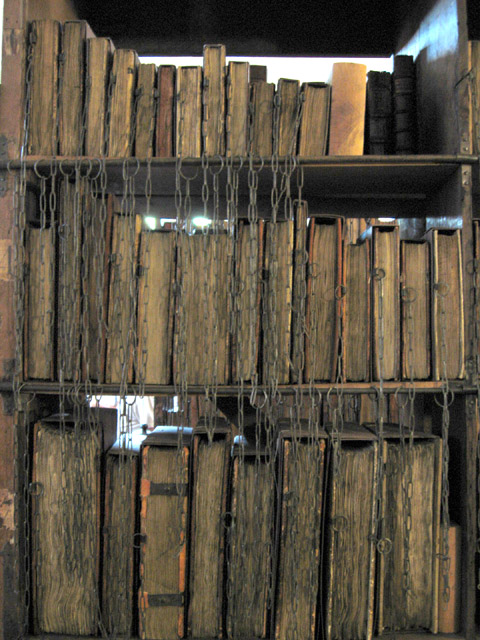
In the libraries unwavering stampede towards complete and total access of all books to everyone, they have also set about to destroy the very things that libraries were originally set up to protect. Don't get me wrong, everyone should have access to books. There just has to be a better way to go about it while protecting the books. It use to be that books where chained to the shelves with just enough slack to take to a nearby table.   There are still plenty of libraries who's books are not open to circulation. For sure every library has those few reference books that can not be taken out or, if the library is lucky enough, a collection of rare books, but I'm talking about libraries that do not let any of their books out. The Grolier Club is a great example. Perhaps I should look into a better way and do a blog about it in the future.


For many people the library is their only source of books and is an indispensable resource when it comes to research. The shear number of books written is staggering and it is impossible for one to get all the books. When those people that collect only certain topics will have a hard time getting everything. What will be interesting to see is what happens to the library with the coming ebook craze. How will they adapt and change? While the slip slowly into obscurity, relegated to preservation only with access to their books only available to academia? I hope not.